
Watch movements (also called calibers) are the “engine” inside a watch — the mechanism that powers the hands, date, and other functions. Here’s a clear list of the main types of watch movements with a quick explanation for each:
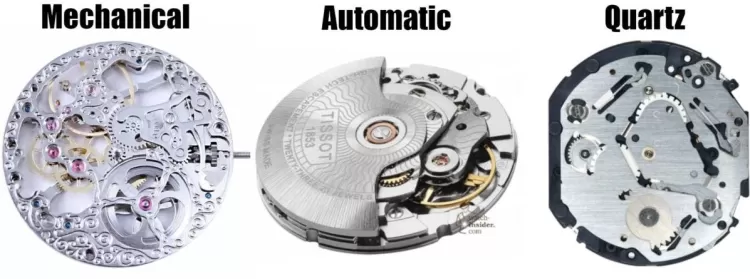
1. Mechanical Movements
Powered by a wound mainspring — no battery required.
- Manual (Hand-Wound):
- You wind the crown to tighten the mainspring.
- Classic, traditional, often seen in dress watches and high-end timepieces.
- Example: Panerai Radiomir, vintage Omega dress watches.
- Automatic (Self-Winding):
- Has a rotor that winds the mainspring with wrist motion.
- The most common mechanical movement today.
- Example: Rolex Submariner, Omega Speedmaster Automatic.
2. Quartz Movements
Powered by a battery that sends electricity through a quartz crystal, which vibrates at a precise frequency.
- Standard Quartz:
- Very accurate (+/- 15 seconds per month).
- Affordable and low-maintenance.
- Example: Casio F91W, Timex Weekender.
- Solar Quartz:
- Uses light to recharge a battery or capacitor (eco-friendly).
- Example: Citizen Eco-Drive, Seiko Solar.
- Kinetic (Seiko innovation):
- A rotor charges a capacitor, combining automatic feel with quartz accuracy.
- Example: Seiko Kinetic Diver’s Watch.
3. High-Tech Quartz & Hybrid Movements
Quartz-based but with advanced features.
- Radio-Controlled / Atomic:
- Syncs automatically with atomic clocks via radio or GPS.
- Always accurate to the second.
- Example: Casio Wave Ceptor, Citizen Atomic Timekeeping.
- Spring Drive (Seiko):
- A unique hybrid: mechanical mainspring + quartz regulator.
- Produces a smooth, gliding seconds hand.
- Example: Grand Seiko Spring Drive.

4. Digital & Smart Movements
Electronic modules display time on screens or offer smart features.
- Digital Quartz:
- Uses LCD or LED displays.
- Often includes alarms, stopwatches, calendars.
- Example: Casio G-Shock, Timex Ironman.
- Smartwatch Movements:
- Miniature computers on your wrist.
- Can track health, show notifications, run apps.
- Example: Apple Watch, Samsung Galaxy Watch.
5. Exotic & Specialty Movements
Rare or artistic movements found in high-end watches.
- Tourbillon:
- Rotating cage to counteract gravity, increasing precision.
- Mostly found in luxury watchmaking.
- Fusée-and-Chain:
- A constant-force mechanism that ensures consistent torque.
- Seen in historic and haute horlogerie pieces.
- Mecha-Quartz:
- Hybrid chronograph: quartz accuracy with a mechanical chronograph module.
- Example: Seiko VK series chronographs.